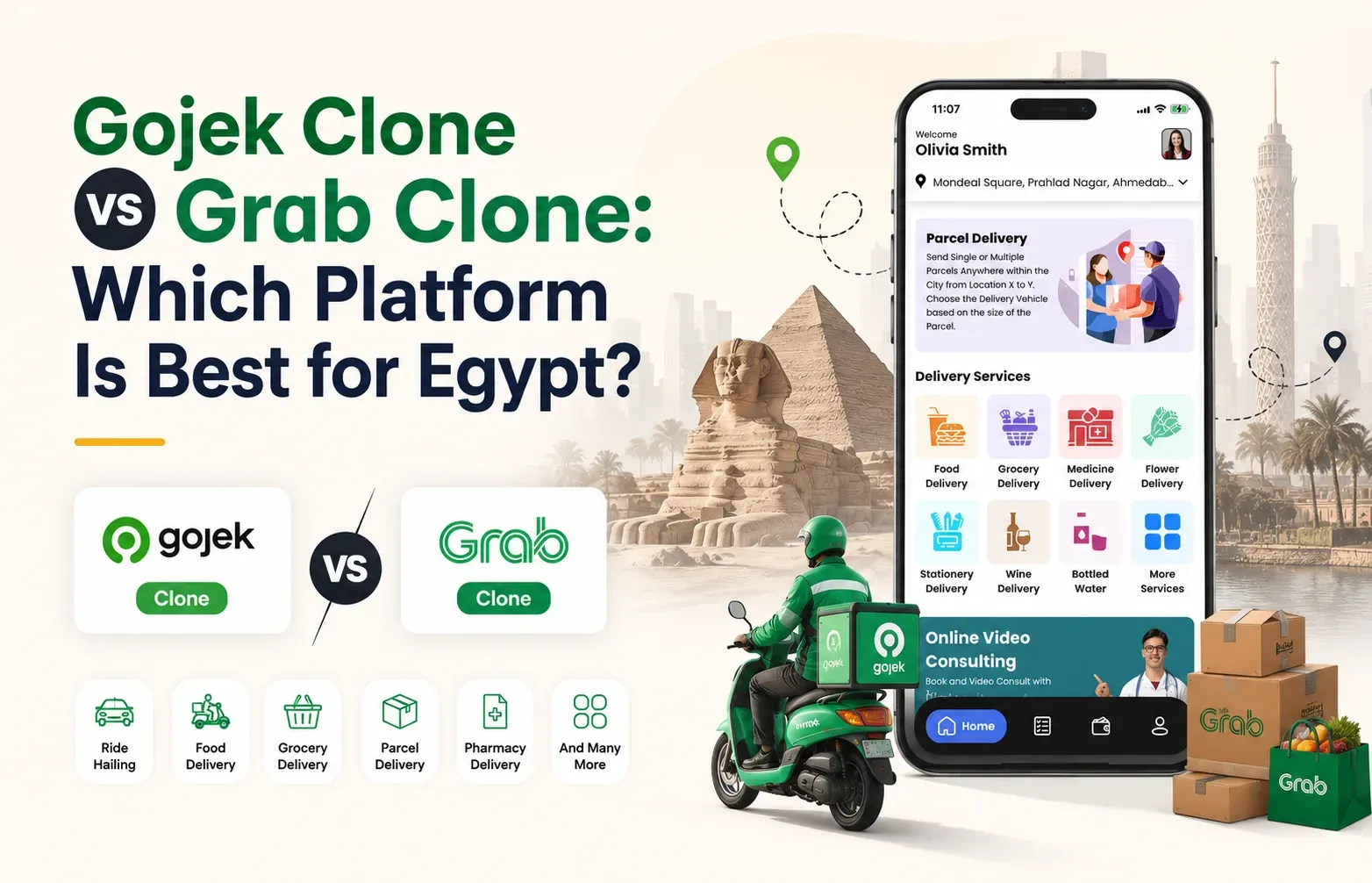
When Indonesia’s Gojek crossed a $10 billion valuation, many Western analysts dismissed it as a uniquely Southeast Asian phenomenon. Egyptian entrepreneurs, however, saw something entirely different: a scalable blueprint for the future of urban commerce.
The online food delivery market size in Egypt in 2025 was USD 542.9 million and is on the rise. It is likely to grow at a CAGR of 4.55% between 2026 and 2034.
Egypt is experiencing the same mobile-first behavioral shift that transformed Indonesia, Singapore, and neighboring Southeast Asian economies into super app powerhouses.
Food delivery is not the only on-demand market booming in Egypt, suggesting huge potential for businesses considering building an on-demand multi-service app. Grab and Gojek are the two popular models in Southeast Asia, and Egypt is no different.
Egypt’s start-up economy is certainly not following the famous phrase, “walk like an Egyptian”. It is increasingly scaling the Indonesian way.
Hence, for founders wondering whether to enter the Egyptian multi-service app market, the real question is whether to develop a Gojek Clone in Egypt or a Grab Clone.
What Is a Gojek Clone App?
The Gojek Clone App is an all-in-one app. It is a multi-service ecosystem designed to consolidate dozens of independent verticals. It is a platform that replicates Gojek’s architecture and consists of some of the common business verticals like ride-hailing, food delivery, grocery, courier, home services, and more.
For Egypt, this model aligns precisely with how Cairo’s urban consumer behaves: the same user who books a morning ride will order lunch, request a handyman, and track a parcel, all before sundown. It is a perfect fit for Egypt’s urban profile, characterized by hyper-dense pockets like Giza and New Cairo. This model delivers immediate transactional liquidity.
What Is a Grab Clone App?
The Grab app is similar to the Gojek app in many ways, in the sense that it too is a super app. However, the Grab model prioritizes depth before breadth and believes in a more phased approach. For example, businesses can start with the ride-hailing or food-delivery app and then gradually add other services like home service, locksmith, and more.
A Grab Clone mirrors Southeast Asia’s Grab app, which is highly popular in Singapore. This model is also suitable for the Egyptian market. This structural framework is highly focused. It allows early-stage start-ups to achieve operational excellence within one domain, securing cash flow and regulatory clearance before scaling the software architecture into a broader multi-service marketplace.
The Grab model is a marathon strategy. The Gojek model is a decathlon, and Egypt’s market just rang the starting gun.
Gojek Clone vs. Grab Clone: Direct Comparison
The table below elaborates on Gojek Clone vs. Grab Clone. That said, both offer similar multi-service features. At the same time, white-label solutions cost significantly less and launch faster, thus saving months of development time and resources.
| Factor | White-Label Gojek Clone | White-Label Grab Clone |
| Launch Speed | 1–2 weeks | 1–2 weeks |
| Day 1 Revenue Streams | 6+ simultaneous | 1–2 initially |
| Market Fit for Egypt | Strong | Moderate |
| Start-up Cost | Lower (bundled) | Higher (sequential) |
| Fintech / Wallet | Native from Day 1 | Added later |
| Scalability | Horizontal across all services | Vertical-first |
| AI Personalization | Platform-wide | Per-vertical, siloed |
Why Egypt Is Becoming a Super App Hotspot
The e-hailing market worldwide is likely to grow to become a $170.11 billion industry in 2029; it is growing at a CAGR of 20.2%. The primary reason for this is a drastic increase in the use of smartphones, urbanization, better network connectivity, and smart city initiatives.
Egypt is actively creating the conditions favourable for building a multi-service app. This is because of the proactive effort from the government in Egypt. Besides this, the Central Bank of Egypt is also promoting cashless payments with native in-app wallets.
There is rising consumer demand, and the urban demographics also favor an integrated urban mobility and lifestyle app. The fact that there are already similar services entering the market is heating up the competition for multi-service apps in Egypt.
When Developing a Gojek Clone in Egypt Makes Sense
The Gojek Clone script generates revenue across six streams simultaneously from Day 1. Founders get the opportunity to maximize their runway, giving them a comprehensive financial advantage.
They can launch ride-hailing commissions, food and grocery delivery fees, courier and logistics charges, home services commissions, digital wallet transaction fees, and more.
The Grab Clone, in its early phase, monetizes one or two verticals and builds toward this diversification over 12–24 months. It follows the strategy of monetizing sequentially.
When a Grab Clone Makes Strategic Sense
Grab Clone is not a complete write-off. It too has its merits. It is the stronger choice when:
- The founding team holds deep operational expertise in a single vertical
- Local regulations require separate licensing per service category
- The target city has low smartphone penetration or limited multi-service demand
- The GTM strategy is a premium positioning over mass adoption
However, such conditions are less likely to favour the Egyptian market, making developing a Gojek Clone in Egypt the right choice.
Expert Analysis: The Start-up “Sweet Spot”
For founders who have committed to the Gojek model, platform selection is as consequential as market selection. Navigating this competitive terrain requires enterprise-grade technology that eliminates development risk.
When it comes to Gojek clone app development in Egypt, considering the state-of-the-art market, you are better off developing a white-label Gojek App as offered by the popular Gojek Clone development company, V3Cube. They have a well-tested and proven solution that is the perfect fit for the Egyptian market.
You can launch your business in under 2 weeks, and this includes over 100 business verticals like ride-hailing, food, grocery, courier, home services, and an integrated digital wallet, precisely the service stack Egypt’s urban consumers are actively demanding within a single interface.
The right platform doesn’t just save months of development. It eliminates entire categories of strategic risk. When you order the Gojek Clone app from V3Cube, you get access to a highly efficient platform that includes many advanced AI features as well.
The Verdict
Egypt’s urban density, accelerating digital infrastructure, underbanked population, and fragmented competitive landscape all point to the same conclusion. The Gojek Clone model is the superior choice for Egypt-focused start-ups in 2026.
The Grab Clone is a disciplined strategy for patient markets. Egypt is neither patient nor waiting; it is a market in rapid digital transition. Founders who arrive with a complete platform will define the ecosystem. Those who arrive with a single vertical will become a feature inside someone else’s super app.
FAQ
1. What is a Gojek Clone app, and how does it work in Egypt?
A Gojek Clone is a multi-service app that bundles ride-hailing, food delivery, courier, home services, and digital payments under one app and wallet. In Egypt, it maps directly onto urban consumer behavior in dense cities like Cairo and Alexandria.
2. Is Egypt a viable market for a super app in 2026?
Yes, Egypt’s ride-hailing sector is projected to reach $3.61 billion by 2030, inDrive has confirmed Egyptian super-app expansion, and Digital Egypt’s infrastructure investments are building strong adoption conditions.
3. How does a Gojek Clone differ from a Grab Clone for startups?
A Gojek Clone launches all services simultaneously with six-plus revenue streams from Day 1. A Grab Clone expands vertically over time, offering lower initial complexity but significantly slower revenue diversification.
4. How much does it cost to launch a Gojek Clone in Egypt?
White-label platforms like V3Cube’s solution are consistently more capital-efficient than custom builds. Exact pricing depends on customization scope, but bundled solutions are optimized for start-ups targeting a 1-2 week launch window.