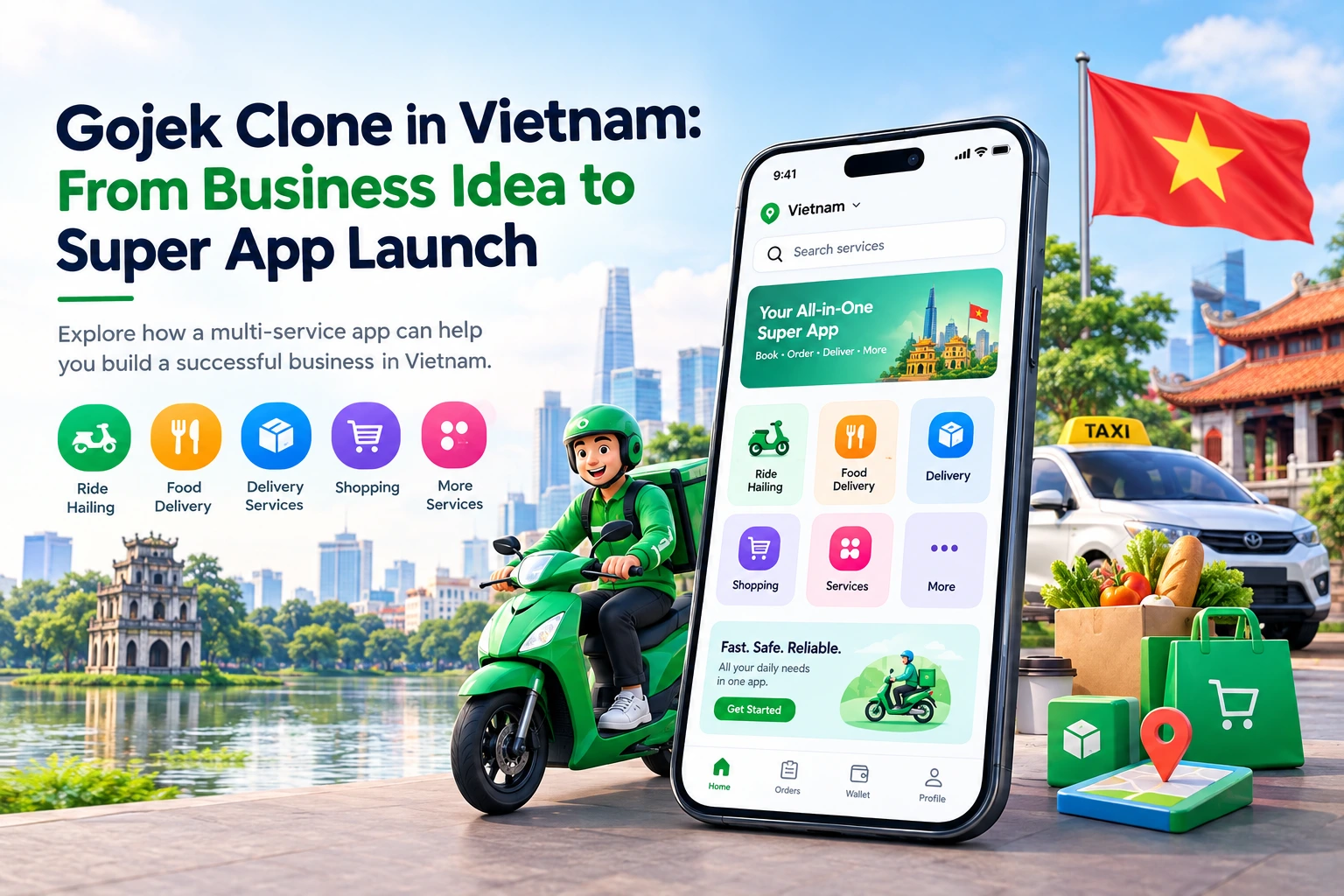
To launch a Gojek clone in Vietnam, it is essential to know that it does not only involve creating an application that has features for delivery and taxis.
A successful Gojek-like business requires having a strategy for local services, carefully selected payment options, a strong network of drivers and providers, competitive pricing, and the appropriate technology to run multiple on-demand services at the same time.
Vietnam has become a perfect destination to follow the super app model due to the possibility of integrating transportation, food delivery, logistics, shopping, and other daily services through one digital ecosystem.
A business can start with a focused service portfolio and gradually expand into a larger Vietnamese super app.
Start With Vietnam, Not With the App
The first step in Gojek clone app development should be understanding the Vietnamese market.
A platform meant for Vietnam must incorporate local transport behavior, transaction preferences, city configuration, delivery demand, consumer choice, and the presence of service providers.
Vietnam’s previous function of Gojek is a worthwhile example. It has included GoRide, GoCar, GoFood, and GoSend in its local services, which connected transportation, food delivery, and logistics into a single ecosystem. Gojek has partnered with MoMo for online wallet payment solutions in Vietnam.
This demonstrates an important principle: a super app should be adapted around local demand instead of simply copying an international feature list.
Choose the Right Vietnamese Launch City
A nationwide launch may sound attractive, but operating several service categories across the entire country from the beginning can create unnecessary complexity.
A more controlled approach is to begin in a major urban market and expand after the operating model becomes stable.
Ho Chi Minh City can provide a strong environment for transportation, food delivery, parcel services, and other urban on-demand categories. Hanoi could turn into another significant growth market in the future, along with Da Nang and others, depending on market requirements.
This city-by-city development will allow Gojek Clone in Vietnam strategy to have the assurance that each city receives due focus in terms of drivers, restaurants, customer base, delivery coverage, and operational excellence.
Build the Service Mix Around Local Demand
A multi-service app in Vietnam should not open with numerous service categories just because it’s technologically possible.
Transportation can be the basis for this application, especially for booking cars and motorbikes. Food delivery will bring the app many customer transactions, while parcel delivery will allow serving both private and business clients.
Other services like grocery delivery, pharmacy delivery, beauty services, home maintenance, laundry, etc., can be added later.
This creates a more manageable expansion model:
Ride-hailing → Food delivery → Parcel delivery → Grocery → Local services → Broader super app
The exact sequence can change according to city-level demand and provider availability.
Make Motorbike and Car Rides Core Services
Transportation should be designed around the realities of Vietnamese cities.
A Gojek Clone app in Vietnam can offer both two-wheeler and four-wheeler travel options. Riders can choose the mode of transport based on multiple factors like distance, price, comfort, and commuting requirements.
The transportation module must feature GPS Tracking, real-time driver matching, fare calculation, payment via digital means, booking of trips in advance, rating of trips, cancellation processing, and earnings for drivers.
Motorcycle transport can be used for riders requiring cheap and convenient transport in urban spaces, while car services can be useful for families, working professionals, airport travelers, and those who are seeking a comfort level higher than usual.
This two-category approach can create a broader transportation base without making the platform dependent on one type of vehicle.
Localize Payments for Vietnamese Customers
Payment integration should be considered an essential part of super app development in Vietnam, not a feature that is added near the end.
Gojek’s partnership with MoMo is a useful example of local payment integration. As part of the collaboration, Vietnamese users were able to link MoMo’s wallet to the Gojek app in addition to having other payment alternatives.
A new platform should accommodate payment types specific to its target customer base, including the acceptance of electronic wallets, cards, bank payment options, and cash payments wherever necessary.
The payment architecture should also handle different transaction types because a ride, restaurant order, grocery purchase, and home-service booking may use different commission and settlement rules.
Design Pricing for Vietnam
The pricing should represent the local competition, expenses incurred by running the service, user expectations, and the expected profit of the service providers.
Transportation can use distance-based or time-based pricing, while food delivery can combine restaurant commissions with delivery fees. Parcel services may use distance, package size, or delivery type.
A super app solution can also support promo pricing and offer discounts to customers, subscriptions, and loyalty programs, and apply corporate pricing.
AI can also increase the efficiency of the pricing process, as it is capable of forecasting demand, enabling operators to modify transportation fares during busy hours.
However, pricing should remain understandable. Clear fare calculation can help build customer confidence and reduce disputes.
Use AI to Manage a Growing Platform
AI becomes increasingly useful as the number of bookings and service categories increases.
In the case of transportation, the use of AI can help with matching drivers to riders, predicting demand, optimizing routes, applying dynamic pricing policy, and solving fraud issues.
A broader platform can leverage AI to facilitate promotion, reservations, payment reports, operational supervision, and evaluation of performance for the providers.
Such capabilities allow for minimizing mundane administrative tasks while providing operators with valuable insights into the performance of the platform.
For the on-demand multi-service app, the use of such automation can be especially useful because it becomes impossible to operate each category manually as the volume of transactions increases.
What V3Cube Offers for a Vietnam-Focused Gojek Business
V3Cube’s Gojek Clone solution provides a broader foundation for businesses planning a Vietnam-focused super app. Its current platform promotes 101+ on-demand services, allowing transportation, food, grocery, parcel delivery, healthcare, home services, and other categories to operate within one ecosystem.
A major difference from a basic clone is the number of operational interfaces. V3Cube supports user applications, driver and service-provider applications, store and restaurant panels, dispatcher systems, fleet management, billing, corporate management, and administration.
This is extremely important for Vietnam, as running a multi-service platform involves distinctive procedures for various workflows, such as drivers, restaurants, carriers, stores, and administrators.
With respect to localization, V3Cube’s white-label model provides scope for business branding, language and currency options, payment gateways, and SMS channels.
These features make the platform more suitable for Vietnam-focused operations that can start with a few services and subsequently add more features to their super app.
Expand From One City to a Vietnam-Wide Platform
Once the initial operation becomes stable, expansion can happen gradually.
Another city can be analyzed for certain factors such as booking volume, customer loyalty, provider availability, delivery period, revenue, cancellation rates, and some service demand before entering another city.
For example, the business may start offering transportation and food delivery services in Ho Chi Minh City before expanding to the new market of Hanoi. After that, new cities could be added based on market research and operational capabilities.
Moreover, the same technology can be utilized for expansion, as a completely new platform does not have to be established for every city.
This makes multi-service app development particularly useful for businesses planning long-term growth across Vietnam.
A Practical Launch Roadmap
The path to establishing a Gojek-style enterprise in Vietnam can unfold in the following stages:
- Stage 1: Investigate the target city, analyze the competitors, what customers want, regulations, and what types of services can be offered.
- Stage 2: Launch the primary transportation and delivery services and use appropriate Vietnam-based payment methods.
- Stage 3: Build a solid network of drivers, restaurants, and delivery providers.
- Stage 4: Add grocery, parcel, corporate, and other local services.
- Stage 5: Adopt the use of AI, automation, analytics, incentives, and subscriptions to optimize platform operations.
- Stage 6: Expand to other Vietnamese cities based on operational data.
By doing this, the platform gets time to develop into a business rather than attempting to become a super app at once.
Conclusion
It takes more than a group of on-demand features to run a successful Gojek Clone in Vietnam. The platform must also be aligned with Vietnamese customers’ behavior, modes of transport, payment habits, service provider preferences, and city-level operations.
To begin with, transportation can serve as a base service, followed by food delivery, grocery, and local services that will help drive platform usage. The use of Vietnamese payment systems, local user interfaces, flexible pricing, vendor administration, and AI-driven automation of processes will make the operating model even stronger.
With a scalable Gojek Clone app development strategy, businesses can begin with a focused service portfolio and gradually build a Vietnam-wide super app rather than trying to launch every category at once.
FAQs
What is a Gojek Clone Vietnam?
The Gojek Clone in Vietnam is a multi-purpose platform based on the Gojek business model that is adaptable to the needs of customers, providers, payment methods, and local service requirements in Vietnam.
Which services should a Gojek Clone App Vietnam launch with?
The transport and food delivery services can be seen as a starting point, as the platform can expand to parcel delivery, grocery deliveries, corporate services, and other on-demand categories later on.
Why is localization important for Gojek Clone Vietnam Development?
Localization allows the platform to consider the Vietnamese language and payment preferences, as well as pricing, service areas, customer expectations, and provider workflows.
Can a Gojek-like app operate in multiple Vietnamese cities?
Yes. A scalable platform can support multiple service areas and administrative controls, allowing businesses to expand from an initial city into additional Vietnamese markets.