Developing an on-demand business involves much more than just bringing customers to avail one specific service. Businesses need to find an efficient way to manage the scheduling of services, link customers and service providers, maintain the quality of service, and explore new possibilities for generating income.
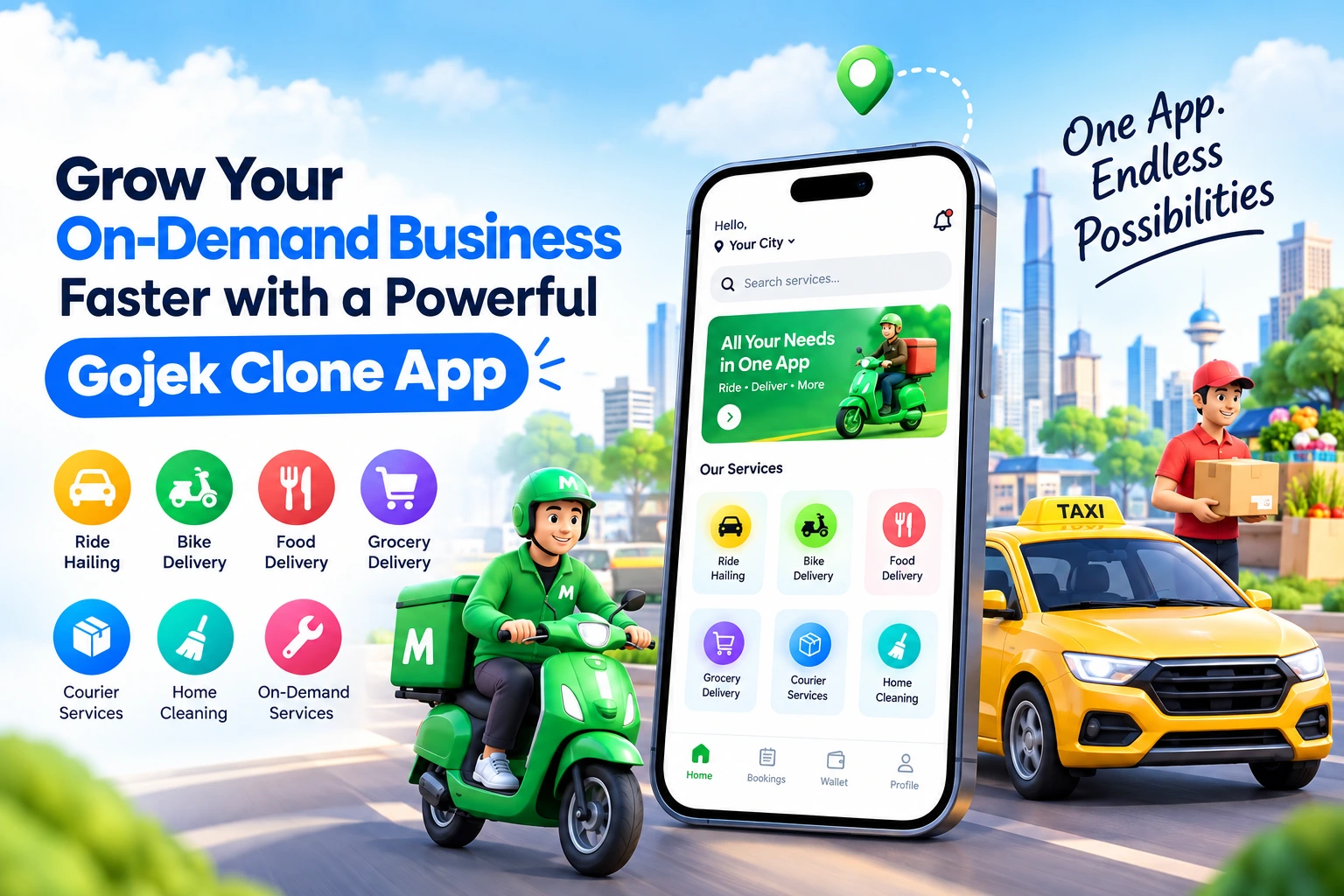
A powerful Gojek Clone app can unite a broad array of services in one digital system, greatly enabling the process of expanding the business category.
The real opportunity lies in connecting services that customers frequently use, making the regular operations simpler and technology offering support in business growth.
Here is how businesses can build that advantage.
Find the Right Opportunity for Growth
For instance, a business might start with providing ride-hailing and food delivery services and later add grocery and parcel delivery services or the repair and maintenance of homes after demand becomes consistent.
Questions to Think Through Before Launch:
- Which services receive the strongest local demand?
- Are enough service providers available?
- How much will each booking cost to fulfill?
- What might motivate customers to come back?
- Which services might cater to the same crowd?
A focused launch minimizes operational complexity and provides important knowledge that helps the venture grow in the future
Turn Multiple Services Into One Connected Experience
Convenience is important for customers who prefer using various services via a single account. For instance, a single platform that covers all aspects of the services enables users to book transportation, order food, buy groceries, or request services without any need for re-registration.
Also, a multi-service application can provide users with cross-service discovery. For example, if someone frequently orders meals, food delivery can later be used for grocery deliveries, or riders booking a taxi can later become interested in scheduled transport.
The advantage is not merely a wider choice of icons on the home screen. Instead, services should provide a cohesive booking experience, straightforward payment, relevant notifications, and accessible customer service.
Develop the Operational Engine for the App
The customers interact with the interface; however, efficiency in operations decides if the company can satisfy the growing demand.
A strong on-demand app must link three essential elements:
- Customers: Look through services, make orders, watch how they progress, pay, and leave feedback.
- Service providers: Accept orders, adjust availability, manage order status, and check revenues.
- Admins: Handle the service provision process, commissions, services, payment process, customers’ complaints, and performance analysis reports.
As the business expands, automation becomes vital. Through automated notifications, smart request allocation, and payout reports, the amount of monotonous work can be reduced, along with operator response time.
Transform Business Information Into Smarter Decisions
Instead of growing under the impression of speculation, pay attention to the facts emerging from day-to-day transactions.
| Business metric | What it reveals |
| Repeat bookings | Whether customers find ongoing value |
| Provider acceptance rate | Whether service requests are attractive and practical |
| Cancellation rate | Where the booking experience may be failing |
| Average order value | How much revenue each transaction generates |
| Cost per completed order | Whether the service model is viable in terms of finances |
The obtained information enables the businesses to discover which services require investment and which services have to be improved.
A properly configured Gojek Clone solution should provide useful operational reports that help to make business decisions based on real performance and not mere assumptions.
Expand Revenue Without Making Services Too Complicated
A multi-service model creates several possible income sources. These might consist of commissions on finished bookings, delivery fees, customer service charges, membership fees, corporate packages, and paid advertising listings.
It is advisable to align monetization with each service individually. In the case of food delivery, commissions can be collected from the restaurants as well as delivery fees, while home services may use provider commissions or fixed booking fees.
Corporate accounts can generate recurring revenue through agreed service contracts.
A Gojek-like app should make pricing clear for customers and providers. High fees may lead to a decrease in repeat orders or cause providers to abandon the platform. In terms of long-term sustainability, achieving balance between clients’ value, providers’ income, and operating expenses is essential.
Choose Technology That Supports Long-Term Growth
Making a technology choice at an early stage can have a good influence on the platform’s evolution. A solution needs to provide service scalability, transaction security, easy administrative management, and integration with relevant payment, mapping, and communication providers.
While developing a Gojek Clone app, businesses should implement only the essential booking processes first and use advanced automation only when the business has enough operational information to apply it properly.
Similarly, on-demand app development should consider not only how much demand and provider onboarding will emerge but also customer support, maintenance, and new features/enhancements that will be added after the launch.
What makes V3Cube worth considering?
V3Cube offers a configurable super-app platform designed to support multiple service categories through a connected system.
Its Gojek app solution comes with panels for user, provider, shop, administration, dispatch, and other operations, and it provides multiple functions like AI-based pricing, fraud detection, automatic payment reporting, and several booking channels.
This complete operating structure is more advantageous than a simple copy of the platform featuring only the customer booking interface
A business can explore a White Label Gojek Clone as the starting point and check what service modules, integrations, and customizations can be offered to the particular implementation of the platform.
Have a Phased Growth Strategy
Growing too rapidly can cause difficulties in the provider network and additional costs related to compliance and service quality. It is better to use progressive steps to improve the performance of the platform before entering new categories or regions.
Stage 1: Define the main service
Provide a few popular services, obtain dependable providers, and evaluate booking, payment, and service processes.
Stage 2. Improve customer retention
Feedback, rewards for loyalty, proper offers, as well as quality of service to increase the chances of customers returning.
Stage 3. Add supportive services
Grow into product lines that are appealing to the same users, service suppliers, and operational resources. Utilize multi-service application development to plan new product offerings without hindering already active services.
Stage 4: Automate and scale
Apply the appropriate artificial intelligence technologies, enhance reporting, and launch in new locations only when the quantity of demand, supplier capabilities, and quality of services can allow it.
An appropriate Super App Development strategy should ensure the sequence of the described above.
However, the functionality of the On-Demand Service App should be straightforward to utilize despite the expansion of service category. The Gojek Clone Software can serve as the technical basis for organizing the service offering.
Conclusion
Having a powerful Gojek clone app helps entrepreneurs bring multiple services, open new revenue possibilities, and grow their everyday transactions.
In order to accomplish long-term growth, businesses needs the right services, an uninterrupted provider network, and enhanced customer satisfaction at each stage of the process.
The best on-demand business solution is that which expands according to the demand instead of adding services for the sake of growing the app.
By utilizing advanced technology and careful planning can transform the multi-service business app into a profitable digital ecosystem.
FAQs
Q1. How does a Gojek clone app help businesses grow?
It combines all the key services to a single platform, providing the ability to make repeat orders, purchase different services together, and generate additional revenue.
Q2. Which services can be included in a multi-service platform?
Depending on the type of business model, it may provide the following services: taxi rides, food and grocery delivery, packages delivery, home services, beauty services, and many other local services.
Q3. What should businesses consider before launching?
Before launching, it is necessary to assess various factors such as consumer demand, choice of services, network of provider, pricing, payment integration options, operational costs and customer service.
Q4. How can businesses choose the right technology partner?
Do not forget to compare features, options for customisation, scalability, security, consulting services, integration options, and total cost of ownership.