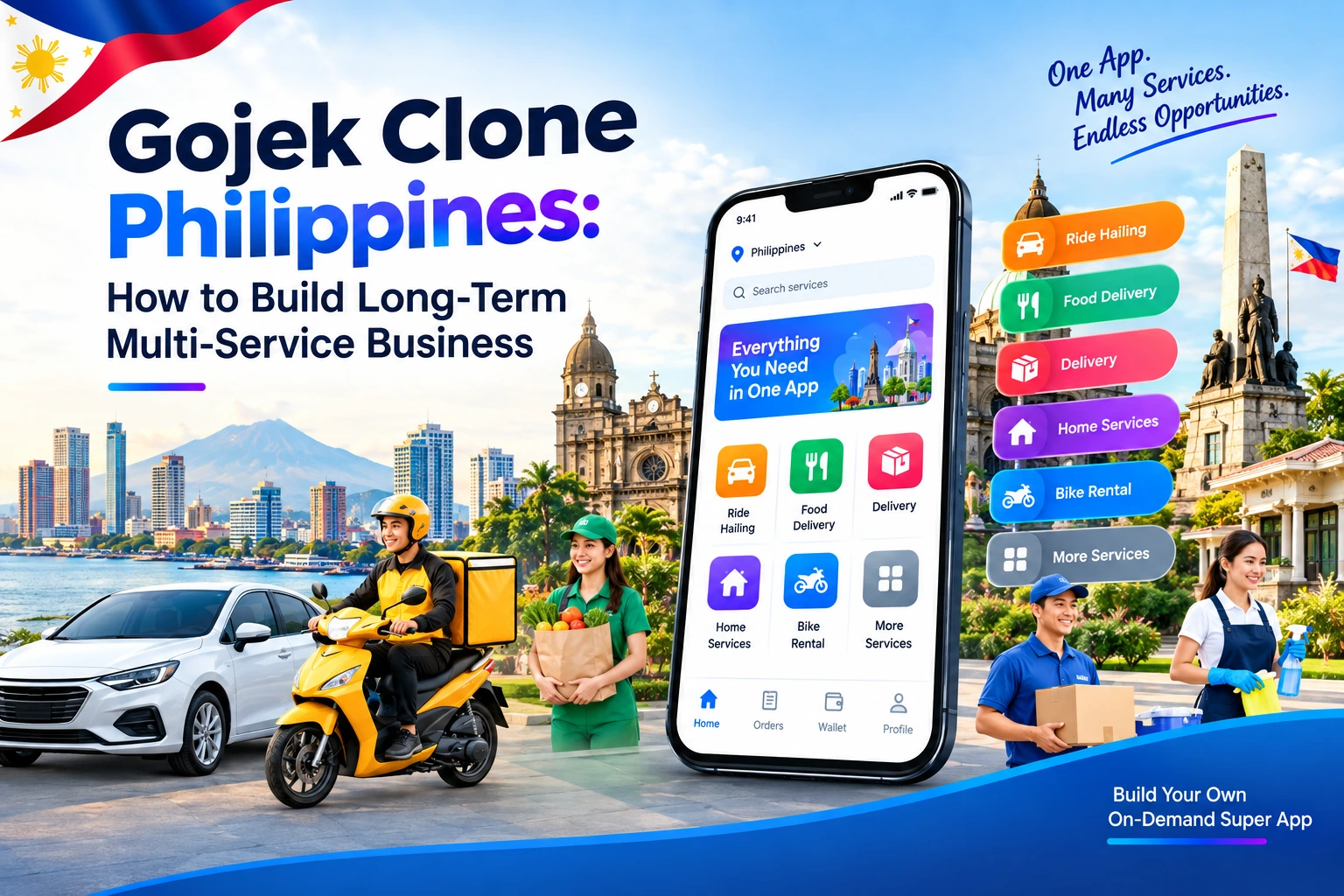
The Philippine on-demand economy creates opportunities for businesses that can bring several everyday services into one digital ecosystem.
Different services such as transportation, food ordering, grocery shopping, courier service, and home services could become part of a single platform instead of existing in different apps. A Gojek Clone in the Philippines provides the foundation for creating this type of multi-service business.
Nevertheless, starting the application is merely the first step. The purpose of Gojek Clone App Development is to develop a platform that grows with the business rather than just replicating features already available in some existing super app.
The Long-Term Goal: Start Small, Build Bigger
One of the mistakes that multi-service businesses make is attempting to introduce every service simultaneously. A better idea is to have a dependable starting point to build upon at a later stage.
A possible growth model looks like this:
Ride-Hailing → Food Delivery → Courier & Grocery → Home Services → Business Services → Wider Regional Expansion
This approach provides the time necessary for the platform to analyze customer behavior and the performance of service providers before introducing excessive operational functions.
When launching a Gojek Clone App in the Philippines, the first version could focus on transportation and one complementary service function. After stabilizing booking, provider availability, payments, and customer support, new categories may be added.
Thus, a slow but steady path toward the development of a larger multi-service app in the Philippines is created instead of trying to create a complete super app from the very first launch.
Build the Philippine Market Into the Platform
A good Gojek Clone Philippines development plan has to be made specifically suited to the local market rather than merely treating the Philippines like any other location for a generic app.
The platform has to account for local patterns of transportation, customer expectations, means of payment, availability of service providers, pricing, and differences between urban markets’ needs.
Business in the field of transportation may have the most promising starting point in a highly populated city, while delivery services may play a significant role as a supporting category. Once customer demand becomes predictable, the same customer base can be introduced to additional services.
Localization should also extend to the application experience. Currency, language options, location services, payment methods, notifications, customer support, and service availability should be configured according to the operating market.
That makes the platform feel like a Philippine on-demand business rather than a generic clone placed in the country.
Revenue Should Expand Alongside Services
A long-term business must utilize a monetization strategy which would follow the technology growth.
A Gojek Clone in the Philippines can generate income through several models:
- Commission: The platform might charge a commission on completed rides, ordering a meal, booking a service, and grocery purchases.
- Booking and Service Fees: Customers may be charged with a platform’s fees or convenience fees as per the service.
- Delivery Charges: There could be charges for delivery of groceries, food, and courier services.
- Subscriptions: Regular customers can be offered membership benefits through subscriptions.
- Corporate Accounts: The platform could generate revenue from companies’ employee transportation, deliveries, and other recurring services.
- Promotional Revenue: Restaurants, shops, and suppliers can pay for the placement of their promotion appearing on the platform.
Thus, monetization should be gradual. In the beginning, growing customer and provider acquisition is more critical; then additional revenue channels can be adopted when the marketplace achieves more significant success.
One App, Multiple Reasons to Return
The real advantage of a multi-service model is not simply having several icons inside one application. This refers to the capability of generating many reasons for a single customer to come back.
For instance, a customer may use the platform to book a taxi ride in morning, buy lunch in the afternoon, send a package later on, and schedule a household service over the weekend. This results in greater customer loyalty towards the application.
There are many considerations such as saved addresses, previous orders for a specific product, payment methods, rewards under loyalty programs, product recommendations based on predetermined criteria, promotions, and scheduling reservations that can support this behaviour.
In the case of super app development in the Philippines, customer retention should be planned right from the start and be part of the app development process, rather than a marketing afterthought.
A Feasible Plan of Expansion
Rather than viewing expansion as a single move, a Gojek Clone in the Philippines can expand in an orderly manner in different phases, where each phase would handle a unique challenge that would help prepare the platform for the next stage of expansion.
Phase 1: Establish the Core
Launch the initial transportation and supporting service categories in a selected market.
Objective: Build reliable operations.
Phase 2: Enhancement of Customer Retention Strategy
Encouraging the use of various services within one application can be achieved through loyalty schemes and individual offers.
Objective: Increase frequency of transactions and lifetime customer value.
Phase 3: Introduction of Complementary Service
Adopt the provision of food delivery service, grocery service, courier, or a selected home service depending on the perceived needs of customers.
Objective: Increase the number of transactions carried out by clients.
Phase 4: Enter New Locations
Utilize the operational knowledge gained from operations in the initial market to enter more places.
Objective: Expand regional scope.
Phase 5: Introduce Advanced Intelligence
AI-based demand forecasting will show areas that will experience increased demand, while intelligent pricing will react to changes in the market.
Objective: Achieve efficiency on a large scale.
This phased approach makes on-demand development in the Philippines feasible since the need for development in each phase is clear.
Where AI Fits Into the Growth Strategy
It is important to implement AI where it can help bring about business improvement.
For instance, demand forecasting can identify locations where drivers and delivery partners are likely to be in high demand. Intelligent matching will allow customers to be matched to the right service provider.
Thus, dynamic pricing enables adaptation to changes in demand, while fraud detection systems can spot any unusual behaviour regarding accounts and transactions. AI can also enable the use of personalized promotions and recommendations.
With the growth of the Gojek Clone App in the Philippines, it may help reduce manual decision-making processes and enable operators to manage a larger marketplace more efficiently.
Why V3Cube Can Support the Bigger Vision
A basic clone may provide booking, payment, tracking, and user management, but a long-term multi-service business needs a broader technology foundation.
V3Cube’s Gojek Clone solution supports a multi-service model with more than 100 service possibilities and multiple operational panels covering users, providers, stores, administration, dispatch, billing, fleet, and corporate operations.
This is important because the goal is not just to create a Gojek Clone in the Philippines and stop there. The technology should be capable of supporting the next service, city, provider group, and automation level.
This makes the platform a more reliable choice for those businesses that consider the clone technology to be foundational infrastructure for their expanded on-demand operations.
From Clone App to Long-Term Business
The distinction between launching an application for the short term and launching a lasting multi-service business is one of planning.
In a short-term approach, the following is applicable:
Launch→ User Acquisition → Promotion Running
On the contrary, the long-term approach appears similar to:
Launch → Supply Creation → Repeat Usage → Services Addition → Revenue Diversification → Location Expansion → Operations Automation → Scaling
The second model gives every development decision a business purpose.
A new service should increase customer value, A new technology feature should improve efficiency. A new city should have sufficient demand and provider supply, A new source of revenue must ensure the sustainability of the operations.
Conclusion
To establish a sustainable Gojek Clone Philippines business, it’s not enough to just imitate the interface of a successful super app.
The main focus should be to develop a robust marketplace that will enable the acquisition of customers, service providers, services, locations, and income opportunities at all times.
Starting with a good selection of services, building a solid provider network, taking care of local specifics, ensuring high customer usage rates, and following a phased expansion approach will be favourable for establishing a solid platform for sustainable growth.
At the same time, by using a scalable Gojek Clone App Development, local operations, AI capabilities, and a flexible business model, it is possible to transform such a platform from the launch of a single service to a multi-service ecosystem, designed for long-term growth.
FAQs
Which services can be added to a Gojek Clone App Philippines?
Depending on the kind of business model being used, transport, food delivery, grocery delivery, courier, home, beauty, laundry, repair, and corporate services can be included.
Why is provider management important for Gojek Clone Philippines Development?
Drivers, vendors, delivery partners, and professionals are the supply side of the marketplace. Availability and quality of service are ensured thanks to advanced provider tools.
How can a multi-service app in the Philippines generate revenue?
Revenue models may include commissions, booking fees, delivery fees, subscriptions, other corporate accounts, premium features, or promotional placements.
Can a Gojek Clone expand to multiple Philippine cities?
Yes. Scalable platforms can be designed in a way that they will be able to expand to new locations later on, after the service has reached a healthy demand from customers and supply from providers.